The True Cost of Downtime: Why Network Reliability Is a Financial Issue for Small Businesses
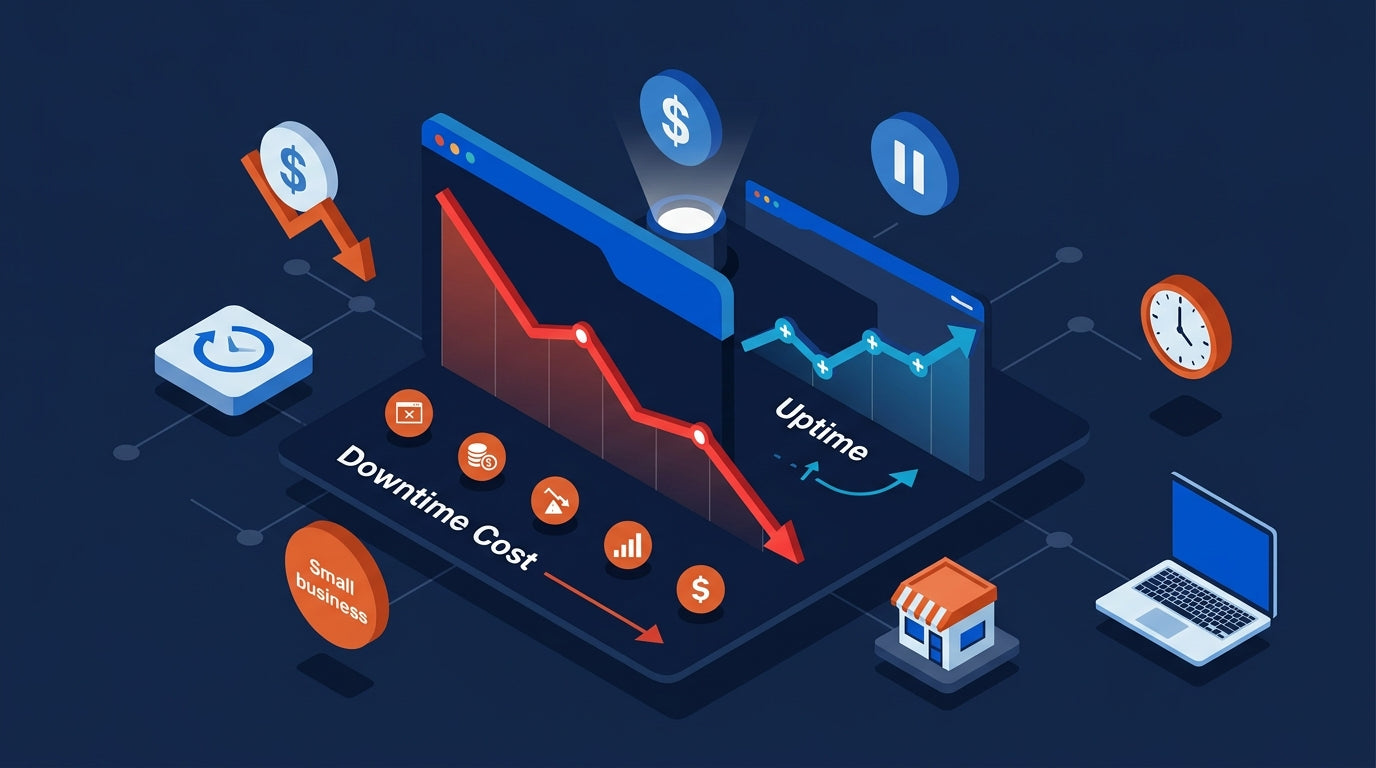
For most small and mid-sized businesses, a network outage still feels like a minor annoyance — the kind of thing you shrug off, wait out, and move on from. That mindset is expensive. Every minute your network is down, your point-of-sale can't process a sale, your team can't respond to a customer, your cameras stop recording, and your cloud apps lock up. Network reliability isn't an IT problem anymore. It's a financial one.
According to Gartner, the average cost of IT downtime is $5,600 per minute — and while that figure skews toward the enterprise, even a small business losing $150–$400 per minute in transactions, productivity, and wages can burn through thousands of dollars in a single afternoon.
Downtime Is More Expensive Than Most Businesses Realize
When the network goes down, the obvious losses are easy to see: missed sales, idle employees, and frustrated customers walking out the door. But those are just the surface-level costs. The real damage is cumulative, and it doesn't end when the Wi-Fi comes back on.
- ✓ Lost revenue — every payment that can't be processed is revenue that may never be recovered.
- ✓ Idle payroll — employees are still on the clock, even when they can't work.
- ✓ Customer trust — a customer who experiences a "system is down, try again later" moment often doesn't.
- ✓ SLA penalties — for service businesses, downtime can trigger contract-level consequences.
- ✓ Emergency IT costs — unplanned support calls, overnight shipping for replacement gear, and after-hours labor add up fast.
For a 20-person business, a single half-day outage can easily translate into $10,000+ in direct and indirect losses. Do that twice a year and you've bought yourself a very expensive problem.
The Hidden Costs Nobody Talks About
The numbers above are the ones you can put on a spreadsheet. The harder costs to measure are the ones that compound quietly in the background — and they're usually the most damaging.
Your team builds workarounds. Customers switch to a competitor "just this once" and never come back. Your cybersecurity posture weakens because staff bypass locked-down systems to keep working. Leadership stops trusting that "it just works," which slows down every future decision about scaling the business. A flaky network doesn't just cost money — it caps your growth.
Reliability isn't a feature you bolt on later. It has to be built into the architecture from day one — across your internet connection, your local network, your wireless, and your cloud apps.
How Cisco Meraki Builds Reliability Into Every Layer
The good news: modern cloud-managed networking was designed specifically to solve this. Cisco Meraki takes reliability out of "hope it works" territory and turns it into an engineered outcome. Every layer of the stack — from the firewall down to the access point — is built to fail over, self-heal, and keep your business online without a tech scrambling at 2 a.m.
Here's what "always-on" actually looks like in a Meraki-powered environment:
- ✓ Automatic WAN failover — when your primary internet drops, Meraki MX security appliances cut over to a secondary link in seconds, not minutes.
- ✓ 5G/LTE backup — Meraki cellular gateways keep critical systems online even when both wired circuits fail.
- ✓ Self-healing Wi-Fi — Meraki wireless access points auto-optimize channels and power so a single AP failure doesn't take down the room.
- ✓ Stackable switching with redundancy — Meraki MS switches support hot-swap stacking so a failed switch doesn't drop the network.
- ✓ Cloud-based alerting — the Meraki dashboard tells you something is wrong before your users do.
- ✓ Remote remediation — most issues can be fixed from a browser, without a truck roll.
A Practical Blueprint for Always-On Operations
You don't need an enterprise budget to get enterprise-grade uptime. The principles are the same whether you're running one office or fifty. Build with resilience in mind from the start, monitor it continuously, and give yourself a human on call who understands the stack.
The sequence we recommend to our clients:
- Dual internet circuits — different providers wherever possible, sized so your primary workloads survive on the backup.
- Cellular failover on critical sites — especially for retail, hospitality, and healthcare where POS or booking systems can't wait.
- Meraki MX at the edge — unified firewall, SD-WAN, and failover in one device with automatic policy enforcement.
- Redundant core switching — stacked switches with PoE budget to spare for cameras, sensors, and access points.
- Proactive monitoring — dashboard alerts tied to your managed IT provider so issues get triaged before they impact users.
- Quarterly reliability reviews — uptime isn't a one-time project; it's a standard you maintain.
Most small businesses discover the true cost of downtime the hard way — by living through it. The businesses that outgrow their competitors don't. They treat network reliability as a line item with real ROI, and they partner with someone who keeps that line item healthy year after year.
If uptime is starting to feel like a gamble, it's time to change the architecture — not just the equipment. Talk to Novbox about building a network your business can actually depend on, or browse the resilience-first hardware that powers it.
This article was originally published on meraki.deal, the Novbox Cisco Meraki online store.


Comments
Post a Comment