Beyond Surveillance: How Cisco Meraki MV Smart Cameras Turn Physical Security Into Business Intelligence
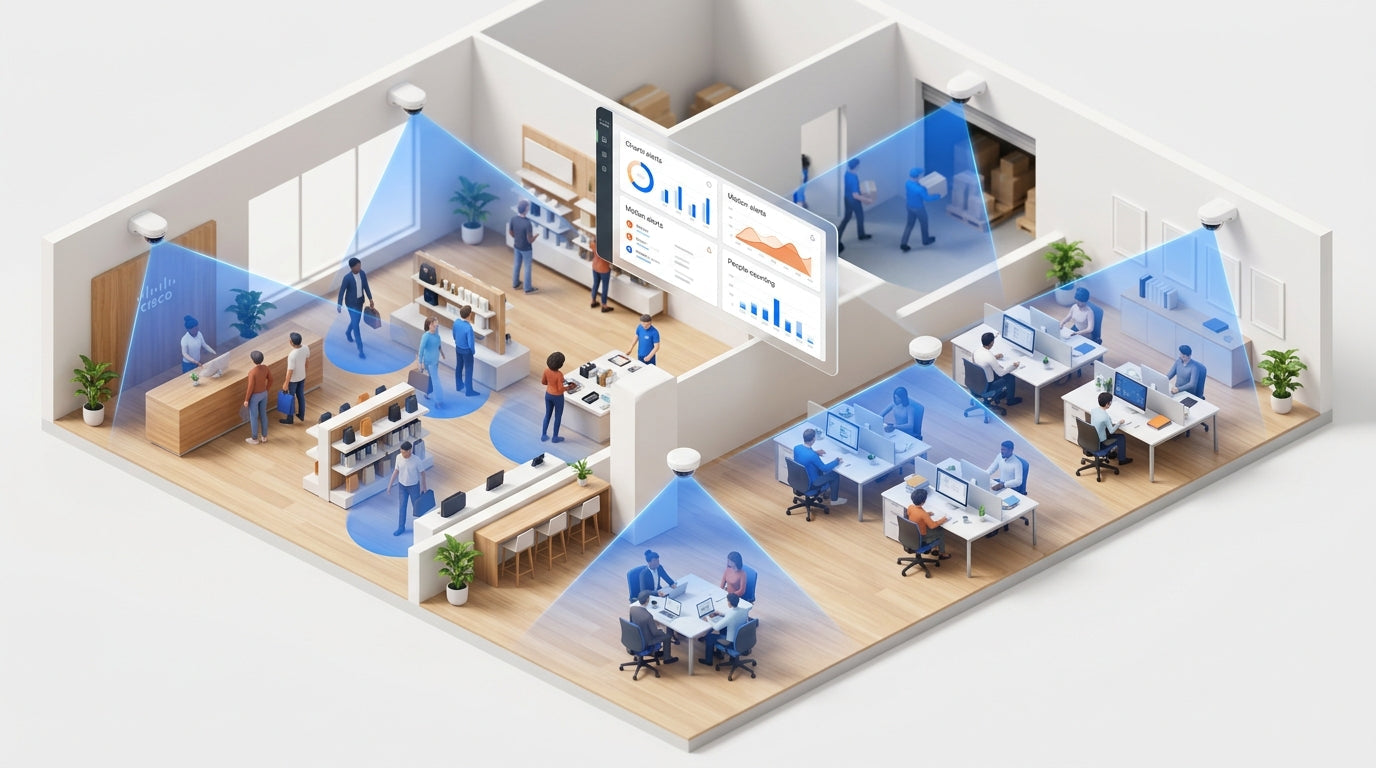
Security cameras used to be glorified DVRs — bulky NVRs in a closet, a tangle of coax cable, and grainy footage no one looked at until something already went wrong. Cisco Meraki MV smart cameras flip that model on its head. Every camera is a self-contained edge computer with cloud management, on-board AI analytics, and solid-state storage built in. There's no NVR, no separate VMS server, and no port-forwarding gymnastics. Just plug it into your Meraki MS switch, adopt it in the dashboard, and you're recording within minutes.
"By 2027, more than 70% of new physical security deployments will rely on cloud-managed cameras with on-device AI, up from less than 25% in 2023." — IDC, Worldwide Video Surveillance Forecast
Why traditional surveillance is broken
Most small and mid-sized businesses inherit a security setup that was designed in the early 2000s. A box in the back office records 30 days of footage, a monitor in a guard station nobody watches, and a remote login that only works if you remember the dynamic DNS hostname. When an incident happens, somebody spends two hours scrubbing through video to find a 30-second clip — assuming the hard drive didn't fill up and start overwriting itself last week.
The Meraki MV line replaces that mess with a fundamentally different architecture: cameras as cloud-managed sensors that record locally, analyze locally, and stream selectively. Footage stays on the camera's solid-state drive (no NVR to fail), but management, search, and alerting all happen through the same browser-based Meraki dashboard you already use for your network.
Edge AI: cameras that actually understand what they see
Every MV camera ships with a powerful onboard processor that runs computer vision models in real time. Instead of streaming raw video to the cloud for analysis (slow, expensive, and a privacy headache), the camera does the thinking on-device and only sends metadata and event clips upstream. That's how a Meraki camera can deliver:
✓ Motion search — find every clip where movement happened in a defined region across days of footage in seconds.
✓ People counting and dwell analytics — measure foot traffic, queue length, and zone occupancy without any add-on hardware.
✓ Object detection — distinguish people from vehicles to cut false alerts and surface what matters.
✓ License plate recognition on MV53X — automate gate access, parking enforcement, and incident response.
✓ Cross-camera tracking in Vision portal — follow a person of interest across an entire site without scrubbing each feed individually.
Built for businesses that don't have an IT department on site
The whole point of a managed cloud platform is that you should never need a screwdriver, a serial cable, or a vendor service call to keep a camera running. Meraki MV delivers on that in three concrete ways:
✓ Zero-touch provisioning — claim a camera by serial number before it even ships. It self-configures the moment it gets power and an internet connection.
✓ No NVR, no VMS, no separate licensing per stream — one license per camera covers cloud management, firmware updates, and storage on the device itself.
✓ Remote firmware and security patching — Cisco pushes updates to the entire fleet from the cloud. No on-site visits, no downtime windows.
✓ Granular role-based access — store managers see only their location, regional managers see their district, corporate sees everything. No VPN required.
Beyond security: cameras as business intelligence sensors
This is where the Meraki story gets interesting. Once your cameras are generating analytics, they stop being a cost center and start producing data that influences decisions. A retailer can compare conversion rates between stores by overlaying foot-traffic counts with point-of-sale revenue. A restaurant can see which sections of the dining room turn over fastest at peak hours. A warehouse can flag the moment a forklift enters a pedestrian-only zone and notify a supervisor automatically.
Combine MV cameras with Meraki MT environmental sensors and you get a unified view of your physical space — temperature, humidity, leak detection, motion, and video, all surfaced in the same dashboard. That's what Cisco means when they talk about "smart spaces": physical environments instrumented with networked sensors that feed business decisions, not just security investigations.
Choosing the right MV model for your space
The MV line covers everything from a small office lobby to a multi-acre industrial yard:
✓ MV13 / MV13M — indoor mini-dome with 4K and an 8.4 MP sensor. The right pick for offices, retail floors, and lobbies.
✓ MV23M / MV23X — indoor varifocal lens for flexible mounting and longer-range views, with up to 120 days of on-camera retention on the X.
✓ MV33 / MV33M — immersive 12.3 MP fisheye with a true 360° field of view. One camera covers a whole conference room or sales floor.
✓ MV53X — outdoor telephoto with license plate recognition built in. Designed for parking lots, gates, and perimeter monitoring.
✓ MV63 / MV93 outdoor lines — rugged enclosures rated for harsh weather and direct sunlight.
Privacy, compliance, and the question of cloud video
The biggest objection we hear about cloud-managed cameras is data sovereignty: "isn't all our footage sitting on someone else's server?" No. With Meraki MV, video stays on the camera's solid-state storage. The cloud never holds your raw footage unless you explicitly export a clip. What does live in the cloud is metadata — motion events, analytics aggregates, audit logs — encrypted in transit and at rest, with role-based access controls and full audit trails for compliance frameworks like HIPAA, PCI DSS, and CJIS.
That architecture also makes Meraki cameras dramatically more bandwidth-friendly than legacy IP camera systems. Because raw video isn't being uploaded continuously, you can deploy a 16-camera site over a normal business broadband connection without saturating the link.
The bottom line for SMBs
Meraki MV smart cameras turn physical security from a once-a-year capital project into a managed cloud service that scales with you. You don't need a dedicated security team to run it. You don't need a server room to host it. And you get business intelligence as a side effect of doing security right. For any business that's still running an old NVR and praying it doesn't die before the next budget cycle, this is the upgrade that pays for itself.
This article was originally published on meraki.deal, the Novbox Cisco Meraki online store.


Comments
Post a Comment